
India's Only Digital Academy for Leaders of tomorrow!

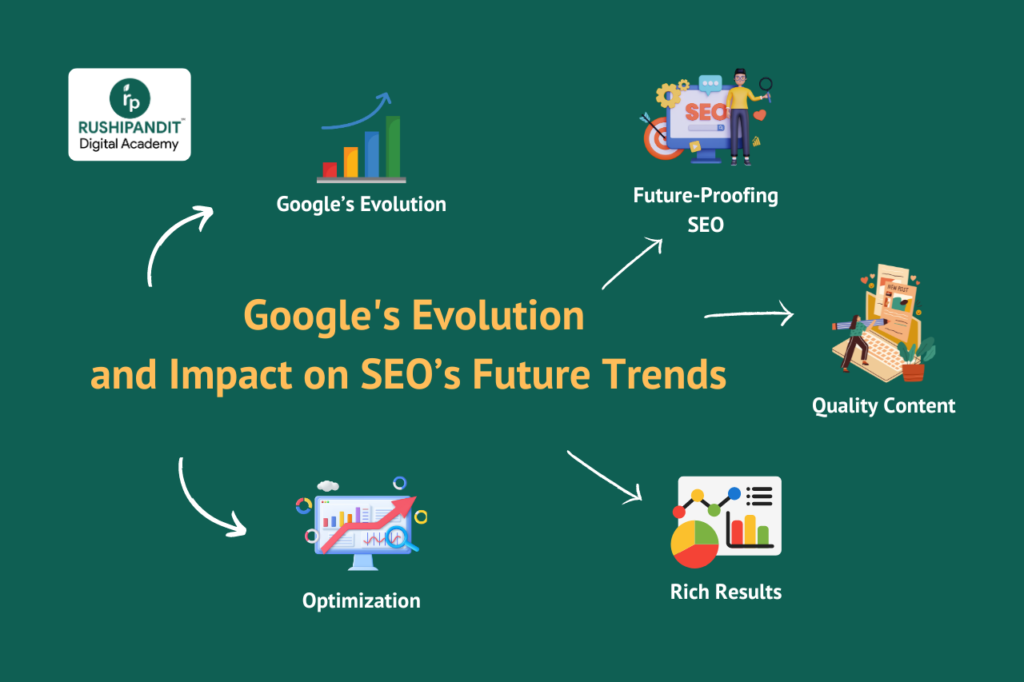
Google's Evolution: Navigating SEO's Future Trends

Google’s Evolution: Navigating SEO’s Future Trends

SEO's future

In the ever-evolving landscape of digital marketing, staying ahead of the curve is essential for maintaining visibility and relevance. As Google continues to refine its algorithms and update its search engine policies, businesses must adapt their SEO strategies to remain competitive in the online marketplace and secure their place in SEO’s future. In this comprehensive guide, we’ll explore the evolving landscape of Google’s search algorithms, the latest trends shaping SEO practices, and actionable insights to help you future-proof your digital presence.

Understanding Google’s Evolution:

Google’s search algorithms are continuously evolving to deliver more accurate, relevant, and user-friendly search results. From major algorithm updates like Panda, Penguin, and Hummingbird to the introduction of AI-driven technologies like RankBrain and BERT, Google is constantly refining its algorithms to better understand user intent and deliver high-quality content.

SEO's future

Key Trends Shaping SEO Practices:

1.User Experience (UX) Optimization:

Google prioritizes websites that offer a seamless and intuitive user experience. Focus on mobile responsiveness, page speed optimization, intuitive navigation, and clear calls-to-action to enhance user satisfaction and engagement.

2.Quality Content Creation:

Content remains king in the realm of SEO. Invest in creating high-quality, relevant, and authoritative content that addresses the needs and interests of your target audience. Embrace diverse content formats such as blog posts, videos, infographics, and podcasts to cater to different user preferences.

SEO's future


3.Semantic Search and Natural Language Processing (NLP):

With the rise of AI-driven technologies like BERT, Google is increasingly capable of understanding the context and nuances of search queries. Optimize your content for semantic search by focusing on natural language, contextually relevant keywords, and long-tail queries.

4.Featured Snippets and Rich Results:

Featured snippets, knowledge panels, and rich snippets dominate the SERPs, offering users quick answers to their queries. Optimize your content for featured snippets by providing concise, structured, and well-formatted answers to commonly asked questions in your niche.

Google’s March 2024 Core Algorithm Update:

Google’s March 2024 Core Algorithm Update marks a significant change in SEO. With this Update, Google aims to reduce unhelpful content in search results and highlight valuable, high-quality, original content. Therefore, aligning your SEO strategy with this new Update is crucial.

SEO's future

Actionable Strategies for Future-Proofing Your SEO:

1.Stay Abreast of Algorithm Updates:

Monitor Google’s algorithm updates and industry trends to stay informed about the latest changes affecting SEO practices. Follow reputable SEO blogs, attend webinars, and participate in industry forums to stay ahead of the curve.

2.Focus on E-A-T (Expertise, Authoritativeness, Trustworthiness):

Establish your brand as a trusted authority in your industry by demonstrating expertise, authoritativeness, and trustworthiness in your content. Invest in building backlinks from reputable sources, cultivating positive reviews and testimonials, and showcasing credentials and certifications.

3.Optimize for Voice Search:

As voice search continues to rise in popularity, optimize your content for voice search queries by using conversational language, answering commonly asked questions, and targeting long-tail keywords and natural language phrases.

4.Prioritize Local SEO:

 With the increasing prevalence of “near me” searches and location-based queries, optimize your website for local SEO to improve visibility in local search results. Claim and optimize your Google My Business listing, ensure NAP (Name, Address, Phone Number) consistency across online directories, and solicit positive reviews from satisfied customers.

Conclusion:-

In the dynamic realm of SEO, adaptation is the key to success. By understanding Google’s evolving algorithms, embracing emerging trends, and implementing proactive strategies, businesses can future-proof their SEO efforts and maintain a competitive edge in the digital marketplace. Stay informed, stay agile, and stay ahead of the curve to ensure sustained visibility and growth in an ever-changing digital landscape.

LinkedIn | Facebook | Instagram | Home 

Related Posts:

SEO BASICS

ChatGPT 5.1: The Complete Guide to OpenAI’s Latest AI Breakthrough

ChatGPT 5.1: The Complete Guide to OpenAI’s Latest AI Breakthrough Share it on 🌟 What Is ChatGPT 5.1? 🕒 Release Timeline​ ⚡ Two New Model Modes in ChatGPT 5.1 🔥 What’s Better Compared to GPT-5? 🎨 Personalization: The Most Loved Improvement 💳 Pricing (No Changes Yet) 🧠 API Access 📊 Performance Benchmarks 🆚 ChatGPT 5.1 vs Claude vs Gemini 💼 Real-World Uses of ChatGPT 5.1 ⚠️ Limitations (Still Important to Know) 🔐 Privacy & Security 🚀 How to Get Started with ChatGPT 5.1 🎯 Final Thoughts Artificial Intelligence is evolving faster than ever — and OpenAI’s latest release, ChatGPT 5.1, has pushed the boundaries again. Launched on November 12, 2025, this update focuses on one clear goal:👉 Make AI feel less robotic and more human while becoming smarter, faster, and more useful. If you’ve been using ChatGPT for business, content creation, education, or development, this update brings a level of refinement that genuinely changes the experience. Below is a simple, human-friendly, and insight-packed guide to help you understand everything about ChatGPT 5.1 — from what’s new to how you can use it in your daily workflow. 🌟 What Is ChatGPT 5.1? ChatGPT 5.1 is a polished, more “human” version of the earlier GPT-5 model. Many users found GPT-5 powerful but emotionally flat. OpenAI listened. With 5.1, everything feels warmer, more conversational, and more intuitive. This version also responds faster, follows instructions more accurately, and adapts its reasoning based on the difficulty of your question. 🔗 Recommended References OpenAI Official Website → https://openai.com(Outbound link for authenticity) Article on GPT-5 advancements → https://techcrunch.com(Outbound link to a trusted tech news source) 🕒 Release Timeline 1. Machine Learning Insights: August 2025 – GPT-5 launched November 12, 2025 – ChatGPT 5.1 released Rollout begins with Plus, Pro, Go, and Business users Enterprise & Education plans get early access Free users get gradual rollout GPT-5 remains available for 3 months before retirement ⚡ Two New Model Modes in ChatGPT 5.1 1. GPT-5.1 Instant (Fast & Natural) Perfect for: Quick chats Email writing Social media posts Short content Everyday conversations It’s friendly, warm, and surprisingly fast — almost like talking to a smart colleague. 2. GPT-5.1 Thinking (Deep & Analytical) Perfect for: Long-form content Coding Research Complex logic & reasoning Business planning This mode thinks more deeply and gives structured, detailed responses. 3. Auto Mode Don’t want to choose?Auto Mode automatically selects the best version for your query. 🔥 What’s Better Compared to GPT-5? ⭐ 1. Follows instructions more accurately Whether you specify: Word count Tone Format Number of points GPT-5.1 sticks to the rules better than ever. ⭐ 2. Feels more human This version understands emotion better, responds more naturally, and maintains context more smoothly. ⭐ 3. Smarter adaptive reasoning It detects: When a question is simple → fast response When a question is complex → deeper thinking ⭐ 4. Better long-context understanding It remembers more across longer conversations — making it excellent for: Customer chats Multi-step tasks Document analysis ⭐ 5. Improved multimodal abilities It can interpret: 3D files Video streams Data visualizations (Some features depend on access tier.) 🎨 Personalization: The Most Loved Improvement Tone presets (8 personality styles): Default Friendly Professional Efficient Candid Quirky Cynical Nerdy This lets you shape ChatGPT’s personality exactly the way you want. Granular tuning options: You can even adjust: Warmth Emoji usage Conciseness Scannability 💳 Pricing (No Changes Yet) Free Plus: $20/month Pro: $200/month Go: Region-based Enterprise: Custom pricing 🧠 API Access Developers can now use: gpt-5.1-chat-latest (Instant) gpt-5.1 (Thinking) The biggest upgrade? 👉 Up to 2 million tokens context window on selected tiers. 📊 Performance Benchmarks ChatGPT 5.1 shows massive improvements: 94.6% score on AIME 2025 Faster coding & debugging 30% faster than GPT-4o Uses 50–80% fewer tokens 🆚 ChatGPT 5.1 vs Claude vs Gemini Feature ChatGPT 5.1 Claude 4.1 Gemini 2.5 Speed Fastest Moderate Moderate Reasoning Exceptional Excellent Good Coding Best Great Average Multimodal Strongest Basic Strong Customization Most advanced Minimal Moderate 💼 Real-World Uses of ChatGPT 5.1 ✔ Customer Support Warmer tone + better clarity = a more human support experience. ✔ Content Creation Blogs, ads, emails — it handles everything more naturally. ✔ Professional Writing Reliable for: Reports Documentation Case studies ✔ Research & Analysis Can process huge documents or long discussions. ✔ Education Great for personalized learning. ⚠️ Limitations (Still Important to Know) Can still hallucinate May reflect biases Knowledge cutoff still exists Free tier limits conversations Sometimes repeats content in long writing 🔐 Privacy & Security OpenAI collects: Prompts Files Device data Usage details To improve privacy: Turn OFF training data in Settings → Data Controls Enable Temporary Chats for sensitive discussions Use 2FA for account safety 🔗 Learn more about OpenAI privacy → https://openai.com/policies/privacy-policy 🚀 How to Get Started with ChatGPT 5.1 For Casual Users Pick a tone preset → start chatting. For Power Users Switch between Instant, Thinking, and Auto. For Developers Use the GPT-5.1 API for apps, chatbots, and automations. For Businesses Use GPT-5.1 for: Customer support Training Content workflows Data operations 🎯 Final Thoughts ChatGPT 5.1 is more than an upgrade — it’s a smarter, faster, and more human version of modern AI. The new personalization features, dual-mode reasoning system, and warm conversational tone make it a tool that adapts beautifully to your working style. Whether you’re writing, coding, planning, researching, or just exploring ideas — ChatGPT 5.1 feels like a genuinely helpful digital partner. Share it on

Read More
SEO BASICS

AI-Driven Personalization: The Key to Engaging Modern Customers

AI-Driven Personalization: The Key to Engaging Modern Customers Share it on The Rise of AI in Personalization How AI Enables Tailored Marketing Strategies Real-Life Examples of AI-Driven Personalization Key Strategies to Implement AI-Powered Personalization The Future of AI-Driven Personalization Conclusion Did you know that 91% of shoppers will buy more and become loyal advocates when brands are showing them personalized offers and product recommendations? Gone are the days of the classic marketplace where brand advertising is often relegated to ineffective mass campaigns and irrelevant generic outreach. In fact, AI personalization has set in motion new avenues for building interactions between brand and audience. Businesses can move above one-size-fit-all strategies because of artificial intelligence and provide experiences related to individual consumers. The Rise of AI in Personalization Impact Overview Highly personalized interaction in terms of communicating to the target audience is changed due to AI. Some key areas where AI-based personalization is truly showing a difference include: Personalized Email Marketing: Personalized emailing, as assisted by AI, studies the pattern and preference of user behavior while delivering email marketing to target potential users. E-mails customized as per the specific requirement have increased rates of opens and engagement. E-commerce Recommends: Like Amazon, most of the business uses AI platforms to recommend particular products based upon past purchases and browsing history. Dynamic Website Content: Websites can now adapt in real-time to display content that matches a visitor’s interests, improving user engagement and conversions. Why Personalization Matters Personalization builds trust, increases customer satisfaction, and boosts loyalty. The more a customer feels understood, the more likely he or she is to return, which increases lifetime value and brand advocacy. How AI Enables Tailored Marketing Strategies 1. Machine Learning Insights: Therefore, machine learning, lying right at the very heart of personalization through artificial intelligence, feeds on huge collections of data relating to customer trends, such as browsing history and purchase history; it also seeks to understand behavioral patterns. Following this, companies can predict demands and provide accurate offers at relevant times. 2. NLP: Natural Language Processing NLP powers virtual assistants and chatbots, thus enabling them to “understand” customer inquiries so that they respond in a conversational tone. Thus, it’s personalizing communications by focusing on specific concerns or preferences. 3. AI-Driven Segmentation Traditional segmentations can be made primarily using demographics or location, but AI refines this by understanding individual behaviors so businesses may make the most hyper-targeted campaigns to micro-segments, ensuring maximum relevance. Real-Life Examples of AI-Driven Personalization Case studies Netflix: The recommendation engine used by Netflix uses AI to go through the viewing history. It helps to pick shows and movies that best fit specific tastes, boosting retention in viewers. Amazon: The product recommendation engine of Amazon personalizes the recommendation based on previous searches. Starbucks: Starbucks uses AI in its loyalty program. It offers customers tailored offers on the basis of their history of purchase and preferences. Before-and-after analysis Netflix: Recommendations were generic before AI. After AI, the engagement on the platform increased by 75% with personalized content recommendations. Amazon: Personalized product recommendations drove a 35% increase in revenue. These examples bring to life the real-time advantages of implementing AI-driven personalization strategies. Key Strategies to Implement AI-Powered Personalization Checklist for Success Data Collection and Analysis: Begin with the collection of customer data on preferences, behavior, and demographics. Choose the Right AI Tools: Check out tools like Salesforce Einstein or Adobe Sensei to make your personalization efforts a breeze. Test and optimize: Using A/B testing, fine-tuning personally addressed campaigns that deliver best-effect results. Prioritize data privacy: gain customer trust through compliance with regulations on data protection and transparency over data usage. Challenges to Consider Over-Reliance on Automation: Human oversight is necessary to keep campaigns empathetic and authentic. Ethical Data Usage: Ethical Usage of Data Respect customer privacy Avoid invasive data collection practices. The Future of AI-Driven Personalization Emerging Trends Voice-Based Personalization: Virtual assistants like Alexa and Google Assistant personalize experiences through voice commands. Hyper-Personalization: Real-time data streams allow businesses to create ultra-personalized experiences. AI in AR Shopping: Combining augmented reality with AI makes shopping more enjoyable and personalized. Expert Insights John Doe, a digital marketing strategist, states, “The future of marketing lies in hyper-personalization powered by AI, enabling brands to connect with customers like never before.” Conclusion AI-driven personalization has changed business-to-customer engagement, because it allows closer relationships and heightened loyalty. Applying AI tools creates experiences that may go beyond the norm of generic campaigning, thus gaining a competitive advantage in a seemingly saturated marketplace. If you missed the previous part, make sure to read it here. Don’t miss out on valuable insights! Stay tuned for our next blog! Share it on

Read More
SEO BASICS

Social Media Marketing Strategy: From Planning to Execution

Social Media Marketing Strategy: From Planning to Execution Share it on Why a Social Media Strategy Matters? Step 1: Define Clear Goals Step 2: Understand Your Target Audience Step 3: Choose the Right Platforms Step 4: Develop and Share Original Content Step 5: Implement a Content Calendar Step 6: Engage, Monitor, and Optimize Real-world Case Studies: Success Stories Common Mistakes to Avoid Conclusion Social media has revolutionized how businesses operate, personal brands grow, and communities connect. It has billions of active users all over the globe. Instagram, LinkedIn, and Facebook are no longer optional tools; they have become essential to use. Yet, posting does not equal a strategy; what’s needed is a well-crafted social media marketing strategy with measurable results. Follow with actionable steps, real examples, and some insights to make you plan a winning social media strategy. Whichever type of business might be, owner, marketer, or someone needing the building of personal brands, this blog has everything it takes to kick start. Why a Social Media Strategy Matters? A comprehensive social media marketing strategy aligns your efforts with your goals and resources for maximum ROI. Here are a few key areas where a strategy makes an impact: 1. Brand Awareness and Visibility Social media is helping businesses and people to reach more audiences quickly. Statista estimated that 4.9 billion people use social media worldwide. Therefore, social media has become a primary space to increase visibility. 2. Lead Generation and Conversions With Instagram and LinkedIn, businesses can capture leads through targeted ads and calls to action. 3. Customer Engagement and Retention Social media creates a two-way communication channel to connect with audiences and build loyalty for brands. 4. Competitor Differentiation An effective strategy helps your brand stand out in a saturated market by showing a unique value proposition. Expert Insight: Neil Patel, a leading digital marketing expert, says, “Without a strategy, you are posting into the void. A good social media strategy is your map to success.” Step 1: Define Clear Goals Every successful campaign will start with one clear goal. Use the SMART framework: Specific: Focus on a specific outcome for example, increase Instagram followers. Measurable: Define metrics of success, for example, 20% growth in followers. Achievable: In regards to your resources, set possible goals. Relevant: Ensure it aligns with the overall business objectives. Time-bound: Attach a deadline (within three months). Case Study: A bakery in a neighborhood set a three-month goal for increasing its number of followers on Instagram by 20%. It successfully posted high-quality product images and also interacted with users, whose number increased 30% on the platform and subsequently led to a rise of 15% in in-store sales. Step 2: Understand Your Target Audience This means getting to know who you are addressing.   Demographics: Age, location, gender, income. Interests: Hobbies, preferences, pain points. Behaviors: Buying patterns, online activity. Tools to use: Facebook Audience Insights Google Analytics Social media platform analytics Real-World Example: A fitness brand targeting young professionals found out that their audience loves short, motivational videos. By adjusting their content, the engagement rates shot up to 40%. Step 3: Choose the Right Platforms Each has some unique strengths. Select those, which match both your objectives and intended audience. Platforms to Consider Instagram: Suitable for visual brands, such as fashion and food. LinkedIn: Best for B2B and professional services. TikTok: Great for reaching Gen Z with short, creative videos. Case Study: A small B2B tech firm initially focused on Instagram but saw poor results. Shifting to LinkedIn and sharing industry insights generated 50 high-quality leads in six months. Step 4: Develop and Share Original Content Original content builds authenticity and trust. Here’s how to create content that resonates: Show Behind-the-Scenes: Share your process or workplace culture. Use User-Generated Content: Encourage customers to share photos using your products. Engage Through Storytelling: Craft narratives around your brand’s journey or values. Example: A personal brand sharing behind-the-scenes videos on Instagram doubled its follower count within a year. Step 5: Implement a Content Calendar Audiences’ interests are kept with consistency. Advantages: Prompts timely publishing. Aids in balancing promotional, educational, and entertaining types of content. Tools to Use: Buffer HootsuiteSample Calendar: Day Content Type Platform Monday Educational Blog Post LinkedIn Wednesday Product Showcase Instagram Friday Live Q&A Facebook Case Study: A retail brand using a content calendar improved engagement by 25% over six months. Step 6: Engage, Monitor, and Optimize On social media, it’s a two-way street. Engaging with replies and DMs is a way of winning hearts and gaining people’s confidence. Tools for Social Listening: Brandwatch Sprout Social Example: Based on audience feedback, a clothing company optimized their product descriptions and got a better conversion. Key metrics to track: CTR (Click-through Rate) Impressions Conversions Real-world Case Studies: Success Stories Case 1: An online small e-commerce business had teamed up with micro-influencers, resulting in sales up by 150% in the first three months. Case 2: A personal brand Tweeted out string threads on industry trends which earned him about 10 000 followers a year. Common Mistakes to Avoid Poor Clear Goals: Causes wasted effort and poor returns. Over-Promoting: Focus on providing value over selling. Ignoring Analytics: Missed opportunities for optimization. Pro Tip: Always review your metrics to understand what works and what doesn’t. Conclusion Building a great social media marketing strategy is about clear goals, understanding the target audience, the type of platform, original content, and continuous optimization. Start small, adapt, and let data guide growth. Share it on

Read More
SEO BASICS

Beginner’s Guide to SEO for New Websites: Early Wins and Long-Term Success

Beginner’s Guide to SEO for New Websites: Early Wins and Long-Term Success Share it on Why SEO is Crucial From Day One? Selecting the Right Domain and Hosting Creating a Content Strategy for a New Website Building Initial Backlinks Tracking Early SEO Results Early Wins Checklist for New Websites Long-Term SEO Strategies for Sustained Growth Conclusion Starting a new website is great, but what comes with the excitement is a key responsibility: make sure people are able to find it. To do this effectively, SEO on a new website proves to be pivotal. From the very first day, search engine optimization can determine the success level of your site by improving your visibility, thereby building authority as well as ensuring organic traffic through the site. In this guide, we walk through the initial steps to take for a successful SEO strategy and show you how to make early wins while setting up for long-term success. Why SEO is Crucial From Day One? Importance of SEO for New Websites One easily focuses on designing and content in a new website launch. If not for SEO, your site might remain unseen to search engines like Google. With SEO, you rank high in search results so that you reach your target audience easily. It also increases trust, authority, and credibility-all critical success factors for long-term success. By implementing SEO for a new website from the beginning, you are setting up a continuous flow of organic traffic, which is much more sustainable and cost-effective than relying on paid advertising. Real-World Example/Case Study For instance, let’s look at a small e-commerce business which has set up a website that sells eco-friendly merchandise. Initially, this business optimizes its site with the keywords such as “sustainable products” and “eco-friendly gifts,” hence it registers 50 percent more in organic traffic within three months. Its products are found through search engines to attract more potential customers to their site. Brief Mention of SEO’s Impact Early on, the impact is most pronounced; for instance, through SEO comes a rise in user engagement coupled with higher ranking searches and makes websites appear more trusted by search users. Thus, for new sites, it offers momentum in those initial phases before gaining a firm footprint on the online stage. Selecting the Right Domain and Hosting Importance of a Good Domain Keyword use forms the backbone of basic SEO. Keywords are words or phrases entered into a search engine when one is searching for something. They connect between what a person is trying to find and what he has. The knowledge to identify good keywords and how they could be integrated into a website will come in handy. Hosting Considerations Your hosting speed and reliability do play an important role in your SEO. Poorly hosted sites are punished by search engines and a lousy hosting experience reduces user engagement, so pick one that can promise fast loading, excellent uptime, and great security. Case Study or Personal Experience Upgrading to a faster, more secure hosting plan caused a 30% drop in the bounce rate of a new blog on plant-based recipes and led to a 25% increase in organic traffic. Site performance and rankings dramatically improved after such a change, highlighting the value of reliable hosting for SEO with regard to the success of a new website. Creating a Content Strategy for a New Website Keyword Research and Selection The engine behind any successful SEO strategy lies in effective keyword research. Tools like Google Keyword Planner and Ahrefs will help you figure out which are the best keywords to target according to search volume, competition, and relevance to your content. When just getting started, use long-tail keywords, which are much less competitive yet still relevant to your niche. Content Creation Tips High-quality original content is a means to ranking high in the search results. Keyword usage has no meaning here, but actual value to the reader is what’s crucial. It should be written blog posts and articles, along with landing pages that answer the question, provide a solution, and give readers valuable information. Original Content Example For instance, one local coffee shop blog was enjoying organic growth very well by working on long-tail keywords, such as “best coffee in [city]” and “how to make the perfect cup of coffee.” Because of these very specific keywords, this blog started to rank on page one within three months, creating more local traffic to their website. Quote from Industry Expert: “Content is still king. High-quality, user-focused content is one of the most important factors for SEO success.” – Neil Patel Building Initial Backlinks What Are Backlinks and Why They Matter Backlinks are the links from other websites pointing to your site. The search engines consider them votes of confidence and may increase the domain authority as well as enhance the rankings of your website. Creating backlinks early may make your new website acquire the required authority to rank higher. How to Build Backlinks for New Websites Start by sourcing guest posting opportunities on industry-related blogs, collaborate with influencers, and submit your website to online directories. All backlinks you have from a credible source enhance your SEO efforts. Real-World Example A digital marketing company was the next startup: Within three months of publishing on respectable marketing blogs as guests, rankings for critical terms in this company improved to 40 percent. Credible Data & Quote “Websites with more backlinks tend to rank higher on Google. According to a study by Backlinko, the number of backlinks correlates with higher search rankings.” Beginner’s Guide to Content Strategy How to Track SEO Progress SEO success can be measured by tools such as Google Analytics and Google Search Console, through which you can analyze important metrics that concern you, such as organic traffic, keyword rankings, bounce rate, and conversion rates. Make sure you have the proper goals created and monitor your site at regular intervals. Setting Realistic Expectations It’s a long game. Weeks may pass, and sometimes even months, before one can see

Read More